FIFA World Cup 2026 Location and Viewing Guide
The year 2026 has ushered in the most massive and thrilling sporting event on the planet. Welcome to the ultimate FIFA World Cup 2026 Location and Viewing Guide, your comprehensive resource for navigating this historic tournament. For the first time in history, the tournament features an expanded format with 48 national teams playing a total of 104 matches, making it the largest soccer spectacle ever organized.
Whether you are planning to travel to the matches or searching for the best way to watch from the comfort of your living room, we created this FIFA World Cup 2026 Location and Viewing Guide to cover every single detail. From stadium statistics and regional travel logistics to global broadcasting schedules and cord-cutting alternatives, this article is designed to keep you fully prepared. Therefore, grab your jersey, note down the key dates, and let us dive into the ultimate North American soccer journey.
Understanding the FIFA World Cup 2026 Location and Viewing Guide
With 48 national teams playing a total of 104 matches across three massive nations—the United States, Mexico, and Canada—using a comprehensive FIFA World Cup 2026 Location and Viewing Guide is crucial to keep track of the action. This historic tri-national hosting model presents unique logistical circumstances. Consequently, FIFA has divided the 16 host cities into three distinct geographic regions: West, Central, and East. This strategic grouping helps minimize travel fatigue for teams and fans alike during the intense group stages.
Indeed, the geographic spread is vast, stretching from the chilly coastal breeze of Vancouver to the tropical warmth of Miami. To help you conceptualize this massive setup, the tournament’s matches are organized systematically within these zones. Furthermore, this regional structure ensures that kickoff times are scheduled to accommodate global television audiences while respecting the local climates of the host cities. Let us explore the detailed breakdown of how these regions are split across the continent.
The Table of Contents
Before diving deep into the specifics, here is how this FIFA World Cup 2026 Location and Viewing Guide is structured to help you find information instantly:
- Understanding the FIFA World Cup 2026 Location and Viewing Guide
- How to Navigate the FIFA World Cup 2026 Location and Viewing Guide
- The Complete 16 Host Stadiums at a Glance
- Key Takeaways from Our FIFA World Cup 2026 Location and Viewing Guide
- Where and How to Stream Matches Live
- Time Zones and Kickoff Schedules Explained
- On-the-Ground Travel and Fan Festivals
- Frequently Asked Questions
How to Navigate the FIFA World Cup 2026 Location and Viewing Guide
To make the most of this tournament, understanding the sheer scale of the locations is key, and this FIFA World Cup 2026 Location and Viewing Guide breaks down each city’s unique footprint. The three host countries offer vastly different footballing heritages. Mexico, for instance, becomes the first nation to host or co-host the tournament three times, having previously welcomed the world in 1970 and 1986. On the other hand, Canada is hosting the men’s tournament for the very first time, bringing an fresh energy to the global game.
Meanwhile, the United States hosts the majority of the games, utilizing state-of-the-art NFL stadiums equipped with massive seating capacities and modern fan amenities. Because of these distinct environments, travelers must prepare for altitude shifts in Mexico City, humid summer conditions in Miami, and temperate coastal weather in Seattle. Transitioning between these environments requires careful planning, which is why having a clear, localized guide is so valuable for international spectators.
To make your planning straightforward, this FIFA World Cup 2026 Location and Viewing Guide provides an easy-to-read overview of all 16 iconic venues hosting the games. Refer to the comprehensive breakdown below to understand the capacities and locations of each stadium.
The Complete 16 Host Stadiums at a Glance
The choice of stadiums reflects a commitment to architectural brilliance and massive fan engagement. Many of these venues are home to famous American football teams, but they have been temporarily retrofitted with high-quality natural grass pitches to meet strict FIFA standards. Below is a detailed table summarizing the 16 host stadiums, their location, and their estimated seating capacities.
| Host City | Country | Stadium Name | Seating Capacity |
|---|---|---|---|
| New York / New Jersey | United States | MetLife Stadium (Hosts the Final) | 82,500 |
| Mexico City | Mexico | Estadio Azteca (Hosts Opening Match) | 87,500 |
| Dallas | United States | AT&T Stadium | 80,000 |
| Los Angeles | United States | SoFi Stadium | 70,240 |
| Atlanta | United States | Mercedes-Benz Stadium | 71,000 |
| Vancouver | Canada | BC Place | 54,500 |
| Toronto | Canada | BMO Field | 30,000 (Expanded) |
| Guadalajara | Mexico | Estadio Akron | 48,000 |
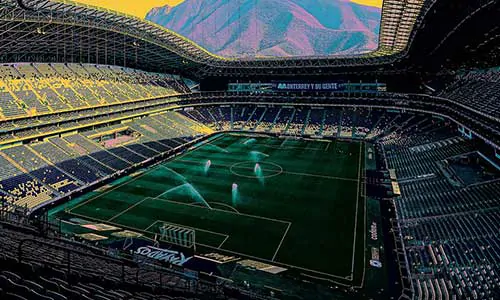
| Monterrey | Mexico | Estadio BBVA | 53,500 |
| Seattle | United States | Lumen Field | 69,000 |
| San Francisco Bay Area | United States | Levi’s Stadium | 68,500 |
| Houston | United States | NRG Stadium | 72,220 |
| Kansas City | United States | Arrowhead Stadium | 76,416 |
| Miami | United States | Hard Rock Stadium | 64,767 |
| Boston | United States | Gillette Stadium | 65,878 |
| Philadelphia | United States | Lincoln Financial Field | 67,594 |
As illustrated in the table, the capacities are massive, ensuring that millions of fans can experience the action firsthand. In addition, the historic Estadio Azteca in Mexico City secures its place in sports history by becoming the first stadium to host matches in three separate World Cups. Consequently, the atmosphere during the opening match on June 11, 2026, is bound to be electric. On the other end of the tournament, the grand finale will take place on July 19, 2026, at MetLife Stadium in East Rutherford, New Jersey, bringing the world together for one final, crowning match.
Key Takeaways from Our FIFA World Cup 2026 Location and Viewing Guide
If you are watching from home, you can consult this FIFA World Cup 2026 Location and Viewing Guide to see which network holds the broadcasting rights in your region. Because the television rights are highly contested, major networks have secured exclusive partnerships to deliver top-tier coverage. Here is a quick reference for the primary broadcasters in the host nations:
- United States (English): Fox Sports holds the exclusive English-language rights, broadcasting matches across FOX and FS1.
- United States (Spanish): NBCUniversal’s Telemundo and Universo provide comprehensive Spanish-language coverage.
- Canada: Bell Media’s CTV, TSN, and RDS are the home of the tournament across the country.
- Mexico: TelevisaUnivision delivers extensive free-to-air and pay-TV coverage, heavily utilizing its ViX streaming service.
- United Kingdom: The BBC and ITV share terrestrial broadcasting rights, keeping the matches free-to-air for British fans.
In addition to these traditional broadcasters, FIFA has partnered with innovative digital services to provide alternative viewing options. For instance, YouTube and TikTok have been designated as preferred platforms, allowing fans to watch select short-form highlight reels, match day analysis, and even the first 10 minutes of every match for free. Therefore, even if you are on the go, staying connected to the live matches is simpler than ever before.
Where and How to Stream Matches Live
The modern sports fan is increasingly moving away from traditional cable television packages. Consequently, this portion of the FIFA World Cup 2026 Location and Viewing Guide will show you how to stream every match legally. If you are a cord-cutter residing in the United States, several subscription-based platforms offer live channels that carry FOX, FS1, and Telemundo. Services such as FuboTV, YouTube TV, Hulu + Live TV, and Sling TV (Blue package) are excellent options that provide high-definition, low-latency streams of the games.
Furthermore, Peacock, NBC’s dedicated streaming platform, is the primary destination for Spanish-language streams of all 104 matches. For those looking for free options, Tubi (a Fox-owned platform) offers select on-demand replays and specific free matches. However, to guarantee access to the complete knockout stages and the final match, a premium live TV streaming subscription remains the most reliable pathway. Be sure to check your platform’s regional availability before kickoff to avoid blackouts.
Time Zones and Kickoff Schedules Explained
Because the tournament is spread across an entire continent, managing time zones is a major challenge for viewers. In addition, this FIFA World Cup 2026 Location and Viewing Guide highlights how different time zones can impact kickoff times. The host cities span four major time zones: Pacific, Mountain, Central, and Eastern. As a result, a match kicking off at 5:00 PM local time in Vancouver (Pacific Time) will air at 8:00 PM in New York (Eastern Time).
Therefore, we strongly advise downloading the official schedule synced to your local calendar. FIFA has deliberately scheduled group stage matches to flow sequentially throughout the day. This layout means you can easily watch multiple matches back-to-back without overlapping schedules. For viewers in Europe and Asia, this means some matches will air late at night or early in the morning. However, the historic nature of these games makes the late-night viewing completely worth it.
On-the-Ground Travel and Fan Festivals
If you are lucky enough to attend in person, this FIFA World Cup 2026 Location and Viewing Guide recommends focusing heavily on regional travel logistics. Traveling between host cities like Seattle and Miami is equivalent to flying across Europe. Consequently, booking domestic flights well in advance is essential. Furthermore, host cities are heavily upgrading their public transit networks, offering dedicated shuttle buses from downtown hubs directly to the stadiums to alleviate traffic congestion.
In addition to the stadium action, FIFA Fan Festivals are organized in every host city. These free-admission zones feature giant public screens, local food vendors, live music, and interactive football activities. Indeed, the sheer distance between host cities makes this FIFA World Cup 2026 Location and Viewing Guide a must-have bookmark for every traveling fan. Whether you are celebrating with thousands of fans at Toronto’s Harbourfront or soaking up the atmosphere in Guadalajara, the Fan Festivals offer a stadium-like experience without the ticket price.
To keep up with official ticket sales, hospitality packages, and stadium rules, we highly recommend checking the Official FIFA Website. Additionally, for the latest match-day lineups and expert television analysis, you can visit Fox Sports Soccer. Having these resources at your fingertips will elevate your overall tournament experience.
Frequently Asked Questions: FIFA World Cup 2026 Location and Viewing Guide
To complete our FIFA World Cup 2026 Location and Viewing Guide, we have answered the most common questions fans ask about this historic tournament. These quick-fire answers are designed to give you instant clarity on the tournament’s structure and viewing requirements.
Which countries are hosting the FIFA World Cup 2026?
As outlined in our FIFA World Cup 2026 Location and Viewing Guide, the tournament is jointly hosted by three North American countries: Canada, Mexico, and the United States. Matches are distributed across 16 unique host cities across the continent.
How many teams are playing in the 2026 tournament?
The 2026 edition features an expanded format with 48 national teams, up from the traditional 32-team format. This expansion allows more nations from every continent to compete, resulting in a total of 104 matches played over 39 days.
Where can I watch the matches for free in the United States?
While most matches require a cable or streaming subscription, select matches may be available via local free-to-air FOX broadcast channels using an over-the-air digital antenna. Additionally, free highlights and short clips are readily available on YouTube and TikTok.
Where will the FIFA World Cup 2026 Final be played?
The highly anticipated final match will take place on July 19, 2026, at MetLife Stadium in East Rutherford, New Jersey (representing the New York/New Jersey host area). The stadium can accommodate over 82,000 passionate fans.
How do I stream the matches in Canada?
In Canada, Bell Media holds the official broadcasting rights. Therefore, fans can stream matches live using the TSN App, CTV App, or RDS App (for French-language coverage) on mobile, tablet, or smart TV devices.
What are the dates of the tournament?
The tournament officially kicked off with an opening match at Estadio Azteca on June 11, 2026. The competition will run through mid-summer, concluding with the grand finale on July 19, 2026.
Conclusion and Tournament Summary
Ultimately, having a trusted FIFA World Cup 2026 Location and Viewing Guide ensures you do not miss a single historic moment. With the dramatic expansion to 48 teams, the tournament promises unprecedented drama, showcasing the beautiful game across some of the most advanced stadiums in the world. Whether you are traveling across borders, watching via local cable networks, or streaming on your mobile device, preparing ahead is the key to an optimal experience.
We hope this FIFA World Cup 2026 Location and Viewing Guide serves as your ultimate tournament companion; feel free to share it with fellow football fans! What match are you looking forward to the most? Make sure your streaming subscriptions are active, secure your local schedules, and get ready to witness football history unfold in North America!