FIFA World Cup Host Selection Process: Evolution Through the Years
The FIFA World Cup is undoubtedly the pinnacle of global sports, capturing the attention of billions. However, behind the matches and stadium cheers lies a complex geopolitical and administrative mechanism. The FIFA World Cup host selection process has evolved significantly over the years, transitioning from informal closed-door agreements to a highly structured, scrutinized, and multi-billion-dollar global campaign. Understanding how FIFA chooses its host nations provides deep insights into the changing dynamics of global football, governance, and international relations.
In this comprehensive guide, we will trace the journey of this selection system from its origins in 1930 to the transparent, audited processes of today. We will also explore the rules, controversies, and future trends that shape how the world’s biggest tournament finds its home.
Table of Contents
- The Early Beginnings of the FIFA World Cup Host Selection Process
- The Rotation System and Cold War Politics (1958–1998)
- Controversies and Reforms in the FIFA World Cup Host Selection Process
- How the Modern FIFA World Cup Host Selection Process Works Today
- Key Bid Requirements and Criteria Comparison
- Future Trends: Joint Hosting and Sustainability
- Conclusion
- Frequently Asked Questions
The Early Beginnings of the FIFA World Cup Host Selection Process
In the initial days of international football, the FIFA World Cup host selection process was far less bureaucratic than it is today. When FIFA decided to launch the inaugural tournament in 1930, there was no complex bidding handbook or multi-billion-dollar infrastructure audit. Instead, the decision was made during FIFA Congress meetings through diplomatic lobbying and financial promises.
Uruguay was chosen to host the first World Cup in 1930 because they had won consecutive Olympic gold medals and were celebrating the centenary of their first constitution. Furthermore, the Uruguayan government agreed to build a brand-new stadium, the Estadio Centenario, and offered to cover all travel and accommodation costs for participating nations. Consequently, despite the massive travel times for European teams, Uruguay secured the hosting rights uncontested.
However, this informal style of selection quickly led to continental friction. In 1934, Italy was chosen to host after extensive campaigning by Benito Mussolini, who recognized the tournament’s immense propaganda potential. Subsequently, the 1938 tournament was awarded to France. This decision broke an unspoken agreement that the tournament would alternate between South America and Europe. As a result, major footballing nations like Argentina and Uruguay boycotted the tournament, highlighting that the early FIFA World Cup host selection process lacked a structured, long-term policy.
Following the devastation of World War II, Europe was in ruins. Therefore, Brazil stood as the only logical candidate to host the 1950 World Cup, which they did uncontested. Similarly, Switzerland was awarded the 1954 edition because the nation was undamaged by the war and housed the FIFA headquarters. Ultimately, these early selections proved that geographical stability and financial security were the absolute priorities during football’s foundational years.
The Rotation System and Cold War Politics (1958–1998)
In order to avoid future boycotts and geopolitical tensions, FIFA introduced a more reliable continental rotation system starting in 1958. Consequently, the FIFA World Cup host selection process adapted to alternate hosts between Europe and the Americas. This informal policy helped maintain harmony between the two dominant powerhouses of global football.
During this era, tournaments were awarded several years in advance. For instance, the 1982 tournament was awarded to Spain as early as 1966. This long preparation time allowed nations to build modern stadiums and improve local transportation systems. On the other hand, the limitations of this rigid approach became clear in 1982, when Colombia, which had been selected to host the 1986 tournament, announced it could not fulfill its hosting duties due to severe economic difficulties. As a result, FIFA reopened the FIFA World Cup host selection process on short notice, ultimately selecting Mexico to step in as the replacement host.
Furthermore, this era marked the rapid commercialization of the World Cup under the leadership of FIFA President João Havelange. He recognized that expanding the tournament to non-traditional footballing nations could yield unprecedented financial growth. Specifically, the selection of the United States to host the 1994 World Cup was a calculated move to capture the massive American sports market. Although traditionalists criticized the decision to award the tournament to a country where football was not the primary sport, the event became the most financially successful World Cup in history, proving that commercial viability was now a permanent pillar of the FIFA World Cup host selection process.
Controversies and Reforms in the FIFA World Cup Host Selection Process
For several decades, the FIFA World Cup host selection process was controlled entirely by the FIFA Executive Committee (ExCo). This small group of 24 powerful executives voted behind closed doors. While this system allowed for quick decisions, it lacked transparency and was highly vulnerable to lobbying, political deals, and financial misconduct.
The system reached a critical turning point in December 2010. During a single voting session in Zurich, the ExCo awarded the 2018 World Cup to Russia and the 2022 World Cup to Qatar. This dual-award decision triggered global criticism and highlighted systemic flaws in the FIFA World Cup host selection process. Many questioned how Qatar, a tiny nation with no major footballing infrastructure and extreme summer temperatures, could win the hosting rights over more established bidding countries.
In addition, subsequent investigations revealed widespread allegations of corruption, vote-buying, and ethical violations within the ExCo. These scandals forced FIFA to launch the Garcia Report, an independent investigation into the bidding processes. The findings of this report, combined with criminal investigations by Swiss and United States authorities, eventually led to the resignation of long-time FIFA President Sepp Blatter and the ban of several executive committee members.
Consequently, rebuilding trust required a fundamental restructuring of the FIFA World Cup host selection process. In 2015, FIFA embarked on a comprehensive governance reform package. The old Executive Committee was dissolved and replaced by the larger FIFA Council. Most importantly, the final power to choose the host nation was stripped from this small committee and handed over to the entire FIFA Congress.
How the Modern FIFA World Cup Host Selection Process Works Today
Under the newly designed system, the FIFA World Cup host selection process utilizes a highly democratic and transparent model. Today, every single one of FIFA’s 211 member associations receives one vote at the FIFA Congress. Additionally, to prevent the backroom deals of the past, all individual votes are made public.
Before any bid reaches the voting stage, it must pass a rigorous assessment by an independent Bid Evaluation Task Force. This task force evaluates candidates on both compliance and risk, scoring bids out of 500 points. If a bidding nation fails to meet the minimum requirements for key infrastructure—such as stadiums, airports, hotels, and transport links—their bid is disqualified before it can even be voted on by the Congress.
Indeed, this modern approach was first put to the test during the vote for the 2026 World Cup. The joint “United Bid” of Canada, Mexico, and the United States competed against Morocco. The evaluation task force provided highly detailed, public technical reports scoring both bids. Ultimately, at the 68th FIFA Congress, the United Bid won with 134 votes to Morocco’s 65, showcasing how the FIFA World Cup host selection process had successfully transitioned into a transparent and auditable format.
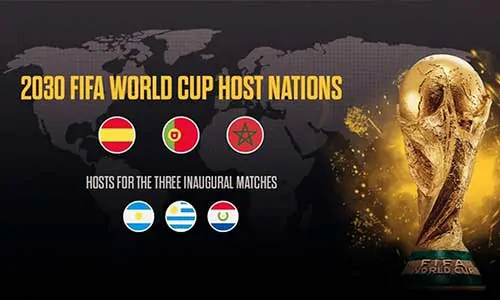
However, the process continues to adapt to unique circumstances. For example, the 2030 and 2034 World Cup hosts were determined through a unified, fast-tracked bidding phase. In December 2024, the FIFA Congress confirmed Spain, Portugal, and Morocco as the primary hosts for 2030 (with ceremonial opening matches in Uruguay, Argentina, and Paraguay), while Saudi Arabia was confirmed for 2034. Rather than an open ballot with multiple candidates, these hosts were confirmed by acclamation, as they were the sole bidders remaining after geographical rotation rules took effect. This showed that while voting is democratic, strategic and continental planning still play a central role in how tournaments are allocated.
Key Bid Requirements and Criteria Comparison
The modern selection process is not just about having the best stadiums; it is a complex audit of a country’s national infrastructure. To understand how dramatically the FIFA World Cup host selection process has changed over the decades, we can compare the historical and modern evaluation criteria:
| Feature | Historical Process (Pre-2018) | Modern Process (Post-2018) |
|---|---|---|
| Voting Electorate | 24 Executive Committee Members (Closed Vote) | 211 Member Associations (Open, Public Vote) |
| Technical Evaluation | Non-binding reports; frequently ignored during voting | Mandatory technical scoring system out of 500 points |
| Human Rights Standards | Not explicitly evaluated or required | Binding commitments required; subject to third-party audits |
| Joint Bids Policy | Discouraged after the 2002 co-hosting logistical issues | Highly encouraged to reduce financial strain on single nations |
| Commercial Potential | Broadly estimated with minimal financial audit | Detailed revenue and commercial projection modeling |
As the table demonstrates, the modern system is designed to minimize financial risk and ensure that host countries possess the actual, audited capability to support a massive global event. More details about these guidelines can be found directly on FIFA’s official website.
Future Trends: Joint Hosting and Sustainability
Looking ahead, the sheer scale of the tournament is reshaping the FIFA World Cup host selection process. With the expansion of the World Cup to 48 teams starting in 2026, the logistical burden has grown exponentially. A 48-team tournament requires at least 12 to 16 modern stadiums, extensive training facilities, and massive hotel capacity to accommodate millions of visiting fans.
Consequently, very few single nations can afford to host the tournament alone without risking financial instability or creating “white elephant” stadiums that remain unused after the event. Therefore, joint bids—such as the USA-Canada-Mexico 2026 tournament and the Spain-Portugal-Morocco 2030 tournament—have become the new standard. By sharing the costs and using existing infrastructure, these multi-nation alliances represent a far more sustainable way to host global sports events.
Moreover, environmental, social, and governance (ESG) factors are now central to the evaluation framework. Bidding nations must now submit detailed human rights strategies and demonstrate how they will mitigate the carbon footprint of the event. Ultimately, the FIFA World Cup host selection process is no longer just about choosing the most prestigious soccer nation; it is about finding partners who can align the tournament with modern environmental and social goals. For a deeper look into how the World Cup’s legacy has shifted over the last century, you can explore Encyclopaedia Britannica’s history of the World Cup.
Conclusion
The evolution of the FIFA World Cup host selection process mirrors the growth of football itself. What began as a series of handshake agreements in hotel lobbies has transformed into a highly transparent, democratized, and audited global campaign. While the transition has been marked by geopolitical disputes and institutional crises, the modern voting model offers a far more equitable and sustainable path forward.
As joint bids and sustainability criteria continue to shape the tournament’s future, fans can look forward to more diverse, creative, and environmentally conscious tournaments. The road to hosting the World Cup remains long and difficult, but it ensures that the world’s most beautiful game continues to be celebrated on a stage that is safe, prepared, and truly global.
What do you think about the shift toward multi-nation joint hosting? Do you prefer a single-country World Cup, or do you enjoy seeing regional alliances host the tournament together? Share your thoughts in the comments below!
Frequently Asked Questions
What is the FIFA World Cup host selection process?
The FIFA World Cup host selection process is the official procedure through which FIFA evaluates and selects the country or countries that will host the quadrennial tournament. This process involves bidding submissions, technical audits, and a final vote.
Who votes on the World Cup hosts now?
Under current rules, the final host is selected via a democratic vote of the FIFA Congress, which is composed of all 211 member associations. Each country gets one vote, and the individual votes are published for full transparency.
Why was the World Cup hosting selection process changed?
The FIFA World Cup host selection process was reformed after the controversial 2010 double-vote that awarded the 2018 and 2022 tournaments. Severe allegations of corruption and vote-buying within the small Executive Committee forced FIFA to establish a transparent, congress-wide voting system.
Can multiple countries host a World Cup?
Yes, joint hosting is highly encouraged in the modern era. The 2026 World Cup in North America is co-hosted by three nations, and the 2030 tournament will feature co-hosts from three different confederations to handle the expanded 48-team format.
How does FIFA evaluate World Cup bids today?
FIFA utilizes an independent Bid Evaluation Task Force that rates bids out of 500 points. Bidders are graded on mandatory infrastructure criteria, commercial viability, environmental sustainability, and human rights standards. Bids that fail to meet minimum technical requirements are disqualified before the voting stage.
What role do human rights play in the selection process?
Human rights are now a mandatory, binding criterion in the FIFA World Cup host selection process. Bidding nations must provide detailed human rights strategies, undergo independent risk assessments, and establish clear policies regarding labor rights, freedom of expression, and inclusivity.