Offside Rule Explained: A Beginner’s Guide to Football’s Most Confusing Law
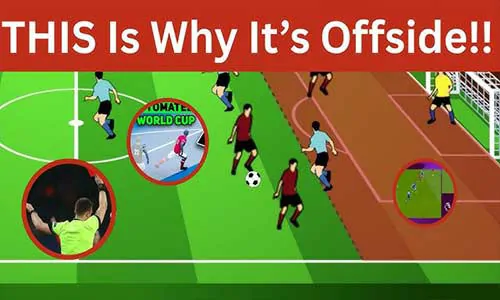
Welcome to the beautiful game of football! If you have ever watched a live match, you have likely heard commentators arguing over a disallowed goal or seen an assistant referee raise their flag. More often than not, this drama boils down to one highly debated regulation. In this comprehensive guide, we provide the ultimate Offside Rule Explained: A Beginner’s Guide to Football’s Most Confusing Law to help you master every detail of this complex rule.
Whether you are a casual fan, a parent of a youth soccer player, or a newcomer trying to follow the World Cup, understanding this law is essential. It shapes how teams defend, how strikers run, and how goals are scored. Consequently, knowing how the rule works will completely change the way you watch the sport.
Table of Contents
- 1. Understanding the Basics of Law 11
- 2. The Evolutionary Journey of the Rule
- 3. The Core Concepts of the Offside Rule Explained: A Beginner’s Guide to Football’s Most Confusing Law
- 4. Offside Position vs. Offside Offence: What is the Difference?
- 5. Tactics and the Offside Rule Explained: A Beginner’s Guide to Football’s Most Confusing Law
- 6. Key Exceptions to the Rule
- 7. Applying the Offside Rule Explained: A Beginner’s Guide to Football’s Most Confusing Law in Modern Matches
- 8. Quick Reference Summary Table
- 9. Frequently Asked Questions (FAQ)
- 10. Conclusion and Call to Action
1. Understanding the Basics of Law 11
To begin our journey, we must look at the official rulebook. The International Football Association Board (IFAB) defines offside under Law 11 of the Laws of the Game. At its most fundamental level, this rule prevents attackers from simply waiting near the opponent’s goal to receive long passes. This tactical exploit is often called “goal-hanging” or “cherry-picking.”
Without this regulation, football would lose its tactical complexity. Teams would simply bypass the midfield, launching high balls directly into the penalty box. Consequently, the sport would become highly repetitive and far less exciting to watch. Therefore, understanding this law is vital for any fan who wants to enjoy the tactical nuances of the game.
To grasp the offside rule explained simply, you must first recognize that being in an offside position is not an automatic infraction. A player can stand in an offside position without committing any offense, provided they are not involved in active play. In the next sections, we will break down exactly how this crucial distinction works.
2. The Evolutionary Journey of the Rule
The offside rule has a long and fascinating history. Originally, the rules were adapted from English public schools in the 19th century. In the early days, any player positioned ahead of the ball was considered offside, much like the modern rules of rugby. As a result, forward passing was virtually impossible, and players had to dribble the ball forward in tight packs.
However, in 1866, the rules were changed to allow forward passing, provided there were at least three opponents between the attacker and the goal line. This change made the game much faster and more strategic. Consequently, teams began to develop complex passing patterns and tactical formations that shaped modern football.
In 1925, the rule was amended again to require only two opponents instead of three. This minor adjustment led to a massive increase in goals scored. In addition, the rule was tweaked in 1990 to declare that an attacker level with the second-last opponent is legally onside. These ongoing adjustments show that the rule is constantly evolving to make the sport fairer and more entertaining.
3. The Core Concepts of the Offside Rule Explained: A Beginner’s Guide to Football’s Most Confusing Law
To understand when a player is in an offside position, you need to look at three key variables. These variables are the player’s location on the field, the position of the ball, and the position of the defensive players. Let us examine each of these components in detail.
The Halfway Line Rule: First and foremost, a player cannot be in an offside position if they are in their own half of the field. The offside line only exists in the opponent’s half. Therefore, if a player is standing exactly on the halfway line or behind it when the ball is kicked, they are completely safe from being flagged.
Behind the Ball: Secondly, a player is not offside if they are behind the ball when it is played. If an attacker dribbles deep into the opponent’s territory and passes the ball backward or laterally to a teammate, that teammate is onside. Consequently, the ball itself acts as a moving offside line whenever it is closer to the opponent’s goal than the second-last defender.
The Second-Last Opponent: This is where most beginners get confused. To be onside, there must be at least two opposing players between the attacker and the goal line when the ball is played. Typically, one of these opponents is the goalkeeper, and the other is the last outfield defender. However, if the goalkeeper runs up the pitch, the two outfield defenders nearest to the goal line become the key markers.
Furthermore, we must emphasize that “level” is considered onside. If an attacker is perfectly level with the second-last opponent, or level with the ball, they are not in an offside position. This allows strikers to time their runs precisely, launching themselves forward at the exact millisecond the ball is kicked.
4. Offside Position vs. Offside Offence: What is the Difference?
As mentioned previously, merely standing in an offside position is not against the rules of football. An infraction is only committed when a player in that position becomes actively involved in the play. Specifically, the referee or assistant referee will penalize the player if, at the moment the ball is played by a teammate, they participate in one of three ways.
Interfering with Play: This occurs when a player actually touches or plays the ball passed by a teammate. For instance, if a midfielder passes the ball forward and an offside striker intercepts it, the referee will instantly blow the whistle to stop the match.
Interfering with an Opponent: On the other hand, a player can commit an offense without even touching the ball. If an offside player blocks the goalkeeper’s line of sight, challenges a defender for the ball, or physically prevents an opponent from making a defensive play, they are interfering. Consequently, the referee will rule them offside to maintain fairness.
Gaining an Advantage: This scenario occurs when a player plays the ball after it has rebounded off the goalpost, the crossbar, or an opposing player. For example, if a winger shoots and the ball hits the post, and an offside teammate puts the rebound into the net, the goal is disallowed. The player gained an unfair advantage by starting their run from an illegal position.
In addition, it is crucial to remember that the offside status is determined at the precise moment the ball is kicked by a teammate, not when the player receives it. This is a common point of confusion. If a player is onside when the pass is made, they can run past all the defenders to collect the ball in an open space. Therefore, timing is absolutely everything in modern attacking strategies.
5. Tactics and the Offside Rule Explained: A Beginner’s Guide to Football’s Most Confusing Law
To fully appreciate this regulation, we must understand its historical significance and tactical necessity. Without the offside rule explained in detail, the strategic depth of modern football would completely vanish. Historically, the rule was introduced to prevent boring, static gameplay where players simply stood near the opposing goal waiting for high balls.
As a result of this rule, football evolved into a highly dynamic and tactical game of movement, space, and coordination. It forces the attacking team to build up plays using creative passing, dribbling, and intelligent runs. Conversely, it allows the defending team to organize their lines and implement advanced defensive tactics, such as the famous “offside trap.”
The offside trap is a coordinated defensive maneuver where the entire backline steps forward simultaneously just before an attacking pass is made. Consequently, this sudden movement catches the attacking players in an offside position, rendering their attack useless. However, this strategy is highly risky; if even one defender fails to step up, the attacker will remain onside and have a clear run at the goal.
In modern football, managers like Pep Guardiola and Jurgen Klopp have refined these systems to perfection. They employ high defensive lines to compress the playing field, making it difficult for opponents to build up attacks. Therefore, mastering the offside rule is not just for referees; it is the cornerstone of elite football tactics.
6. Key Exceptions to the Rule
To make matters more interesting, there are three specific scenarios where a player cannot be penalized for offside, regardless of where they are standing on the pitch. These exceptions are fundamental elements of match strategy and are often utilized to catch defenders off guard.
The Throw-In: A player cannot be offside directly from a throw-in. Therefore, a winger can stand right next to the opponent’s corner flag, receive a throw-in, and legally continue the play. Attackers frequently use this exception to bypass a high defensive line.
The Corner Kick: During a corner kick, the ball is placed on the corner arc, which is essentially on the goal line. Because the ball is almost always ahead of all attacking players, and the kick is taken from the boundary, offside does not apply to the initial pass of a corner kick.
The Goal Kick: If a goalkeeper or defender kicks the ball directly from a goal kick, any receiving attacker is exempt from the offside rule. This allows teams with powerful kickers to bypass the entire midfield, launching direct attacks into the opponent’s defensive third.
Furthermore, it is worth noting that if an attacker receives the ball directly from a deliberate play by a defender (such as a misplaced back-pass or an intentional clearance), they are not considered offside. However, if the ball merely deflects off a defender who is trying to block a shot, the offside rule still applies. This subtle distinction often leads to intense debates on the pitch.
7. Applying the Offside Rule Explained: A Beginner’s Guide to Football’s Most Confusing Law in Modern Matches
In the modern era, officiating this rule has become increasingly complex. Originally, assistant referees had to rely entirely on their eyes to judge offside situations in real-time. Given the incredible speed of modern professional players, making these split-second decisions with absolute accuracy was almost impossible.
To address this challenge, football governing bodies like FIFA introduced the Video Assistant Referee (VAR) system. Today, VAR utilizes advanced camera angles and calibrated lines to review tight offside decisions. Consequently, goals that once would have stood are now frequently ruled out for offside margins as small as a single millimeter.
Additionally, semi-automated offside technology (SAOT) has been implemented in elite competitions. This advanced system uses specialized tracking cameras and microchips inside the match ball to determine the exact moment of contact and the precise positions of the players. As a result, offside decisions are made much faster and with unprecedented scientific precision, reducing controversy and long waiting times during matches.
8. Quick Reference Summary Table
To help you memorize these rules quickly, we have created a simple summary table. This reference guide outlines the key conditions required for an offside offense to be called during a live match.
| Condition | Offside Status | Explanation |
|---|---|---|
| In Own Half | Never Offside | A player must be in the opponent’s half to be considered in an offside position. |
| Behind the Ball | Never Offside | If the attacker is behind the ball when it is played, they are always legal. |
| Throw-In / Corner / Goal Kick | Never Offside | These three set-pieces are completely exempt from the offside rule. |
| Behind Second-Last Opponent | Offside Position | If closer to the goal line than the second-last opponent and the ball. |
| Level with Defender | Never Offside | Being level with the second-last defender or the ball is considered onside. |
9. Frequently Asked Questions (FAQ)
To help you completely master Law 11, we have compiled answers to the most common questions fans ask about this rule. These concise answers will clarify any remaining doubts you might have.
Q1: Can a player be offside if they receive the ball from an opponent?
No, a player cannot be penalized for offside if they receive the ball directly from an opponent who made a deliberate play. However, if the ball simply deflects off a defender, the attacking player is still subject to the offside rule.
Q2: Why do linesmen wait to raise their flags in modern matches?
In the era of VAR, assistant referees are instructed to delay raising their flags if there is a tight offside call and a clear goal-scoring opportunity. This prevents plays from being stopped prematurely. If a goal is scored, VAR can review the entire sequence with high-speed cameras to make the correct decision.
Q3: Is the goalkeeper always the last opponent in the offside rule?
Generally, yes, but not always. The rule specifically states “the second-last opponent.” If the goalkeeper runs out of their box or goes up for a late corner, any two outfield defenders standing near the goal line will act as the reference points for determining the offside line.
Q4: What happens when an offside offense is called?
When an offside infraction occurs, the referee blows the whistle and stops play. The defending team is awarded an indirect free kick from the exact spot where the offside player was positioned when the ball was initially played by their teammate.
Q5: Can you be offside on a penalty kick?
No, you cannot be offside during the initial taking of a penalty kick because all players except the kicker must stand behind the penalty spot. However, if the ball hits the post or crossbar and rebounds into play, an attacking player who encroached into the box before the kick was taken cannot play the ball without committing an infraction.
Q6: Does a player’s hand or arm count when determining offside?
No, hands and arms of all players, including goalkeepers, are not considered when judging offside positions. The boundary is determined by any part of the head, torso, or feet that can legally be used to play the ball. Therefore, only goalscoring parts of the body are measured.
10. Conclusion: Mastering Football’s Most Debated Rule
In summary, while Law 11 may seem overly complicated at first glance, breaking it down into basic elements makes it much easier to understand. By distinguishing between an offside position and an active offside offense, you can quickly analyze match situations like a professional pundit. Furthermore, knowing the key exceptions and the impact of modern technology like VAR helps you appreciate the sport even more.
Now that you have had the offside rule explained, you can watch your next football match with complete confidence. No longer will you be left wondering why a spectacular goal was suddenly disallowed. Instead, you can actively discuss tactics, line setups, and refereeing decisions with your friends.
What is your opinion on VAR’s influence on the offside rule? Do you think it has made the beautiful game fairer, or has it ruined the excitement of goal celebrations? We would love to hear your thoughts! Leave a comment below and share this beginner’s guide with fellow football fans who are still trying to figure out this infamous rule.